Civilization Stack
Collaborative CHTHONIC Continuity

There’s something we’ve silently forgotten.
Ideas don’t float.
Every line of code, every financial product, every algorithm rests on something older, deeper and more fundamental. Rock. Ore. Metal, Wood. Water. Oil. Energy. Earth. Organisms. Farms. Pipes. Wires. Hands that know how to fix things when they break.
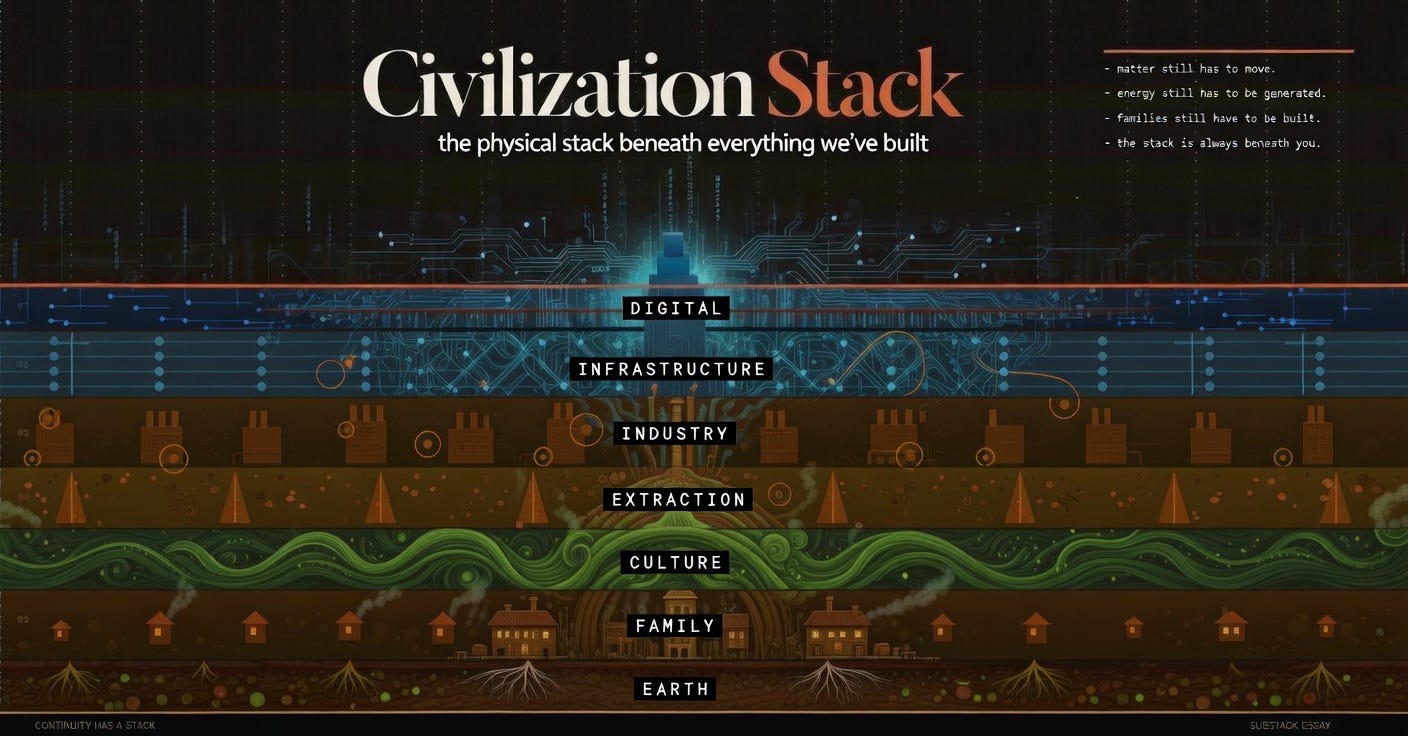
Civilization is a stack. America has been living near the top of it for a while now, pretending the bottom isn’t there.
The Real Stack
Think of it in layers. At the bottom: raw earth. The stuff you dig up, refine, burn, or grow. Above that: the systems that move and shape that matter — mines, refineries, power lines, factories, ports, trucks. Above that: homes, towns, institutions, the rhythms of daily life. And up top: law, software, finance, culture, and now AI.
Each layer depends on the one beneath it.
That dependence is easy to forget when the upper layers appear to be the profitable ones. When the most valuable companies produce something close to refined thought — code, models, interfaces, documents, financial abstractions — it’s tempting to believe the lower layers have been... solved. Outsourced. Automated away.
They haven’t.
A turbine can’t be prompted into existence. A transformer can’t be hallucinated into a substation. A bridge doesn’t stand because a model described it well. Roads are not coded. Somewhere, somebody still has to dig and pour and weld and bolt and inspect and repair.
The uncomfortable part: AI is repricing the upper layers of the stack right now. When your main product is information detached from production, and the cost of generating information is collapsing, your scarcity premium erodes. What used to require teams begins to require tools. What looked rare begins to look abundant. The lower layers — the unglamorous ones, the heavy ones — start to matter more again.
Matter still has to move. Energy still has to be generated. The stack will topple without them…
Stack Continuity
Civilization isn’t a mere economic stack. It’s continuity.
The first layer is biological: DNA, reproduction, life making more life. The second is cultural(family): how we transmit meaning across generations — language, morality, craft, story, expectation. The third is external memory: writing, books, databases, software, AI. The newest layer. The fastest growing.
But the third layer is not sovereign. It can’t survive if the first two collapse.
That’s why the family matters more than modern economists are comfortable admitting.
The family is the smallest durable civilization. A nation isn’t born in Congress — it’s born in households. In children, to parents, in kitchens, at dinner, during duties accepted before they’re fully understood. The family is where biological continuity, cultural transmission, and practical competence fuse into a single living unit. It’s where a child first learns what in their world is ordered, whether sacrifice is normal, whether tomorrow is worth preparing for.
Without that spirit, the roots rot. Without children, the first layer fails. Without moral formation, the second corrodes. You might coast on inherited wealth, institution, and infrastructure for a generation or two…
Nation as an Extended Family Home
Scale this up and the logic holds.
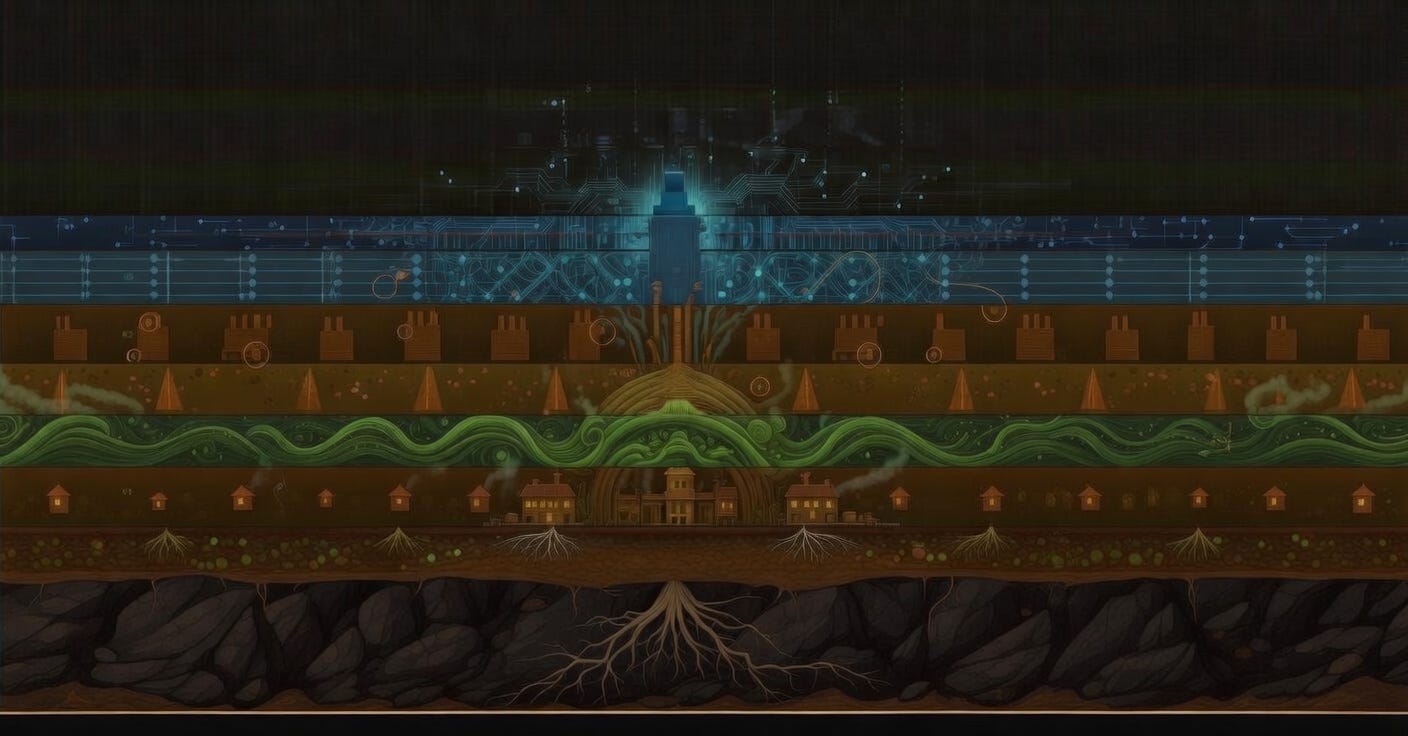
A house needs water, power, waste removal, thermal stability, food, maintenance, and purpose. A town needs all of that with coordination. A city needs a still greater collaboration. A nation is just a large house with borders, memory, law, and enforcement.
And like any house, a nation should know how much of its own stack it maintains.
Can it mine what it needs? Refine it? Generate reliable energy? Build transformers, machine tools, fab semiconductors, weld ships, synthesize fertilizers? Heal diseases? Can it repair what breaks without asking for help? Can it feed itself, move goods, train craftsmen, nurses, doctors, and maintain the habits of competence that keep the family together?
Trade is good. Specialization is good. But there’s a difference between trade and dependency. Trade is a choice. Dependency is a condition.
A healthy nation can participate in global markets while preserving a minimum sovereign stack — enough extraction, energy, tooling, agricultural resilience, and industrial literacy to remain coherent under pressure. Without that, sovereignty becomes theatrical. You’ve still got the flag. Still got the speeches. Yet your material basis and self-direction evaporated.
Intellectual Temptation
The great temptation of advanced societies is to believe intelligence can substitute for infrastructure.
It can’t.
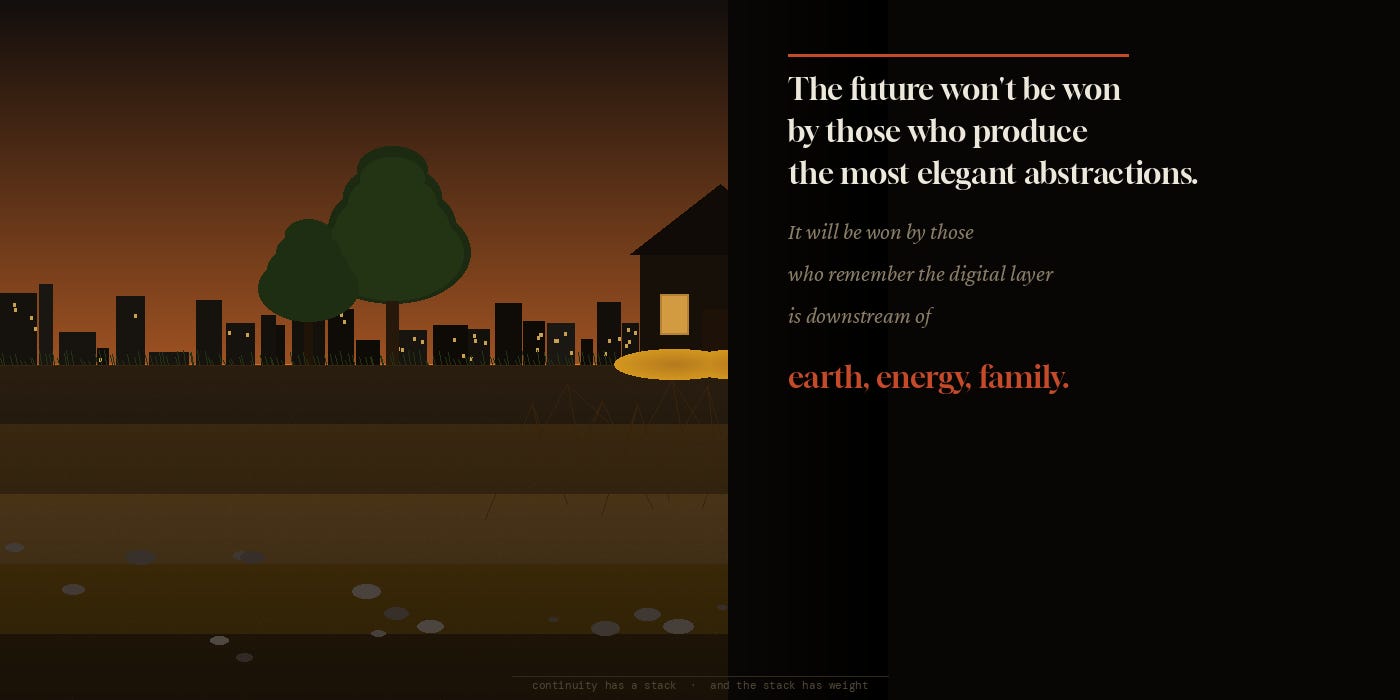
Intelligence helps design the stack. Optimize it. Coordinate it. Implement it. AI may soon automate large portions of it. But it doesn’t erase the stack. The digital layer, for all its brilliance, is still downstream of earth, energy, family, and disciplined human beings who know how to do hard things.
The future won’t be won by whoever produces the most elegant abstractions while neglecting the foundations underneath them.
It’ll be won by the people who remember that continuity carries weight.
By the weight they carry.