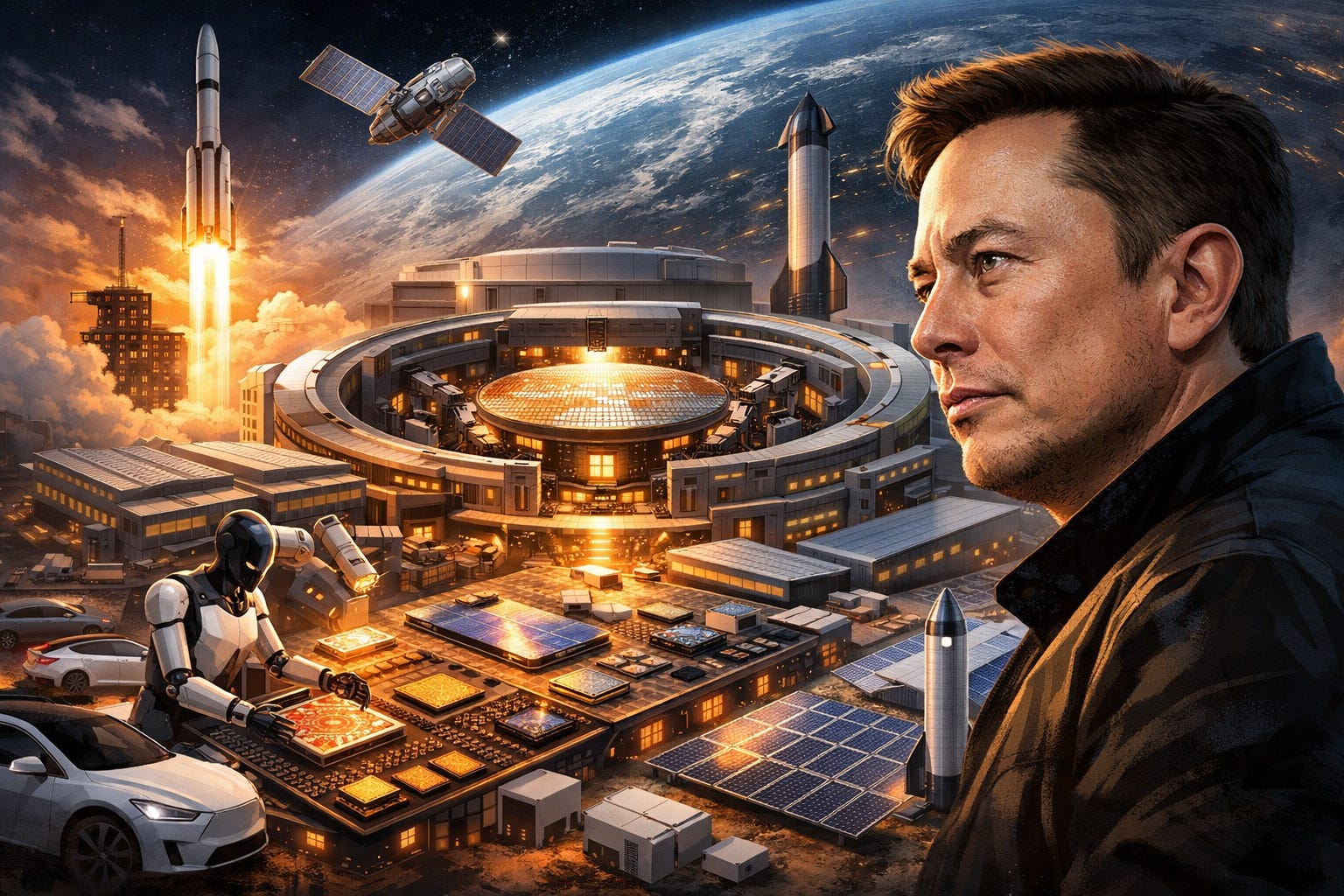
Tesla Terrafab
Super-Dimensionality

A $20–25 billion joint Tesla–SpaceX–xAI chip fabrication project that will rapidly iterate chips, memory, and advanced packaging.
It’s simple: “We either build the Terrafab or we don’t have the chips.” The world’s supply chains can’t keep up with Elon time, so he’s building his own. Again.
This is not just another factory. It’s the latest proof that Musk doesn’t compete on the board as everyone else. He operates in dimensions capital markets cannot see, one where there is no scarcity.
Once you see the vision, you can’t unsee it.
The Philosophy That Runs Everything
Every AI company fights for the same scarce resources: grid power, TSMC wafers, APIs, specialized sensors. Musk’s move is always the same: don’t fight scarcity. Make the resource abundant. Don’t only integrate via code. Live in the world humans already built. Use eyes. Use vision. Let the AI operate exactly like we do.
Engineering Full Stack from First Principles.
Digital Optimus (aka Macrohard): Software Without Code
Announced March 11 with xAI, “Digital Optimus” is an AI agent that doesn’t only call APIs or parse structured data. It watches your screen like a human, processes the last five seconds of video, and moves the mouse and keyboard exactly as you would. No custom integrations. No back-end hooks. Just vision and action. Grok handles the high-level reasoning; the Tesla-trained agent executes.
Your parked Tesla with AI4 hardware can literally do office work for you. Millions of them, worldwide, become distributed compute nodes—powered by Tesla energy, running on Tesla silicon. Everyone else is still begging cloud providers. Musk just turns on the fleet he already sold.
The Fleet: The Largest Real-World AI Training Engine on Earth
Tesla isn’t a car company that added AI. It’s an AI company that sells cars as mobile data centers. Eight cameras per vehicle. 8.4 billion miles logged and counting—another billion in the first 50 days of 2026 alone. That data isn’t just for driving; it trains the exact same neural net that powers Optimus robots and Digital Optimus agents.
Other robotaxi players (Waymo, Cruise) use lidar, HD maps, geofences—city by city. Tesla said no. Solve the intelligence problem, solve it with vision and you solve everything, everywhere, immediately. Same philosophy. Same brain.
Robotaxi: Turning Depreciating Assets into Revenue Machines
Seven million Teslas already on the road. They sit idle 22 hours a day. With the right software, they turn into revenue generators at zero acquisition cost. Owners keep the majority of the take; the network, insurance, and software layer are Tesla’s. Purpose-built Cybercab (under $30k, <20¢/mile) makes personal car ownership optional. Why insure, park, and maintain when a vehicle shows up in three minutes or on a schedule for a fraction of today’s price?
This isn’t competing with Uber. It’s making the entire concept of ownership in transportation obsolete.
Optimus: The Body That Shares the Same Brain
Optimus isn’t a Boston Dynamics competitor. It runs the identical end-to-end neural network as FSD using the same vision stack and the same training simulator. Every mile driven makes the robots smarter. Every task the robots complete makes the cars smarter. One unified physical AI. Factories are already retooling: Fremont for a million Optimus/year, Giga Texas for ten million Gen 4.
Energy: From Earth Grid Scarcity to Orbital Abundance
While Google restarts nuclear reactors and Microsoft buys Three Mile Island power, Tesla deployed 47 GWh of battery storage last year (up 49%), is scaling solar to 100 GW/year in the U.S. and is pairing Megapacks with solar into self-contained mini power plants. Then the real flex: SpaceX’s FCC filing for up to one million solar-powered orbital data centers… The sun never sets in space, no grid fights, no politicians, no land battles. Terrafab’s space-hardened chips are being designed exactly for this.
Musk isn’t begging for power. He’s building the power collectors at scale and putting the compute where the power is free.
Manufacturing & Now Silicon: Closing Every Loop
Traditional automakers bolt one car together sequentially. Tesla’s unboxed process will spit out Cybercabs every 10 seconds, same as consumer electronics are built. Factories build the machines that build the machines.
Logic, memory, packaging, testing, lithography masks, all under one team for iteration loops measured in days, not quarters. No more waiting in TSMC’s line. No more Nvidia dependency. Just rapid, in-house evolution of the silicon that powers FSD, Optimus, Digital Optimus, and orbital supercomputers. The facility itself will be massive, larger than Giga Texas, potentially 100 million square feet.
The Flywheel Is Already Spinning
More cars → more real-world vision data → better AI → smarter robots → cheaper manufacturing → more cars and robots → more energy demand met by Tesla solar/storage → more orbital compute → faster AI iteration → repeat forever.
This isn’t a portfolio of businesses. It’s a single, self-reinforcing physical AI system that spans transportation, labor, software, energy, and silicon. Every layer makes every other layer faster, cheaper, and more capable.
Yes, Execution Risk Is Real
Timelines slip. Capital spend is enormous. Competition isn’t standing still. But the strategic direction has no peer. No one else owns the cars (data), the robots (bodies), the chips (brains), the batteries and solar (power), the factories (means of production), the satellites (orbital infrastructure), and the reasoning engine (Grok) all at once.
The market still prices Tesla like a car company with AI upside. The reality is a full civilizational stack (energy to compute to labor to transport) already bootstrapping itself toward Mars, the Moon, and eventually a Dyson-scale future. The optionality is absurdly underpriced.
Terrafab isn’t the end. It’s the final link in the loop to becoming unbreakable.
Once you see this architecture, everyone else looks like they are still playing checkers while a superior board is being rebuilt around it.
This is a new era. The flywheel is spinning up. The only question is how fast it accelerates and who’s going along for the ride... Are you?